
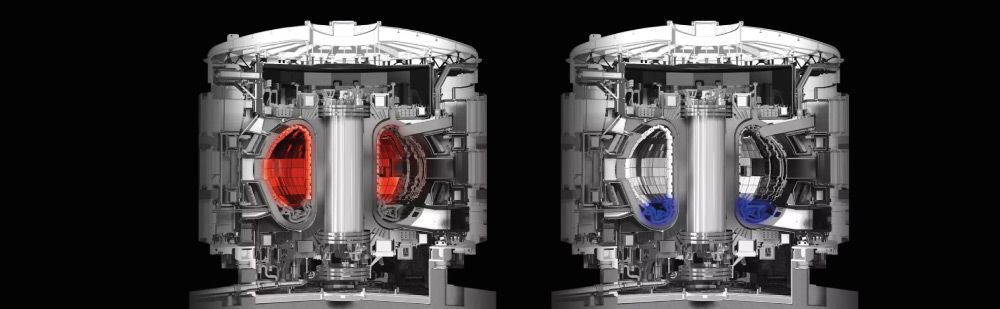
11/06/2026 – The ITER Organisation has ordered from Exail aluminium-coated, radiation-resistant optical fibres for its tokamak reactor. Manufactured in collaboration with Photonics Bretagne’s technological platform, these fibres will be integrated into the largest fusion device in the world, currently under construction in southern France, for critical monitoring applications.
In total, 12 kilometres of optical fibre will be used to build the mechanical control system of ITER’s blanket and divertor — two of the elements most exposed to the plasma within the machine. The fibres will be integrated into cables and fibre Bragg grating (FBG) optical sensors in order to measure deformations, thus contributing to the prevention of mechanical fatigue and the assessment of the residual lifetime of these components located at the heart of the vacuum chamber.
This order granted by ITER is the direct result of the successful development and industrialisation of aluminium-coated optical fibres, capable of operating at temperatures reaching 400 °C and in highly irradiated environments, with a level of maturity equivalent to the world state of the art.
These highly specific optical fibres were developed within the framework of the 3F2E project (2021-2025), led by Exail in partnership with Photonics Bretagne, SEDI-ATI, EDF and TechnicAtome. Financed by the France Relance plan, this project made it possible to structure a “100% Made in France” supply chain of optical fibres for measurement applications in a nuclear environment, directly contributing to the strengthening of the capacities and sovereignty of the national nuclear industry.
According to the ITER Organisation:
The optical fibres intended for the internal applications of the vacuum chamber must withstand extreme conditions: temperatures up to 250°C, a high vacuum, gamma-ray doses on the order of the gigagray (GGy) and a neutron fluence reaching 10¹⁹-10²⁰ n/cm². The radiation-hardened, aluminium-coated fibres supplied by Exail have been selected to precisely meet these constraints.
Mathieu Bergont, Manager of Special Optical Fibre products at Exail, states in turn:
This success confirms once again Exail’s ability to supply special optical fibres for the most demanding operations, notably under extreme levels of temperature and radiation. Exail has strengthened its expertise in the development of radiation-resistant optical fibres through a decade of research collaboration with the experts of the Hubert Curien Laboratory. Following their installation on the NIF (National Ignition Facility) of LLNL in the United States and the successful demonstration in December 2022, this is further proof that our technology can rise to the greatest challenges and contribute to pushing the technological frontiers of high-energy laser and nuclear fusion facilities.
As David Méchin, Director of Photonics Bretagne, concludes:
We are very proud to contribute to a project as ambitious and of such a scale as ITER. This collaboration demonstrates the ability of the Photonics Bretagne teams to develop and master a stable and robust optical fibre metallisation process, fully meeting the industrial requirements for use in extreme environments. This exceptional expertise, acquired within the framework of the 3F2E project, now opens up new development prospects, in particular by combining this know-how with the other fibres in our catalogue (microstructured fibres, active fibres, etc.).
This success indeed confirms the leading capacity of Exail to supply special optical fibres for the most demanding environments. This collaboration also highlights the expertise of the Photonics Bretagne teams, who have managed to develop and master a stable and robust optical fibre metallisation process, meeting in every point the industry requirements for use in extreme environments.