As a technology platform, Photonics Bretagne develops innovative, tailor-made solutions. Its strength lies in its multi-disciplinary R&D team of technicians, engineers and PhD students, who manage the entire production chain for specialty optical fibres and associated components. From design studies to prototyping and characterisation, we offer our customers a very wide range of technical services.
We translate the customer’s application needs into key characteristics that the future fibre must meet (for example, guiding a certain wavelength). We draw on our knowledge of previous scientific work and 20 years’ experience to identify the most appropriate design more quickly.
Overview of the state of the art in technologies of interest
Modelling
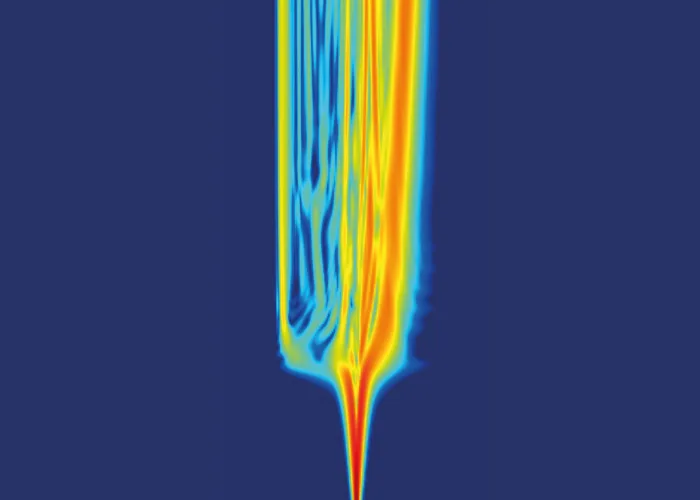
A modelling phase is initiated to validate a target geometry and performance in line with the state of the art in terms of manufacturability. The selected model can then be refined using our preform and fibre prototyping resources. The actual geometry obtained is quantified by microscopic measurement and can be used as a new input parameter for the simulated model in order to estimate more precisely the optical performance achievable by the fibre prototype.
We have the in-house capability to model the guiding properties of optical fibres with complex geometries.
Spectral attenuation, bending losses,
MFD, modal content,
GRIN geometry, birefringence,
Nonlinear pulse propagation.
Preform Fabrication
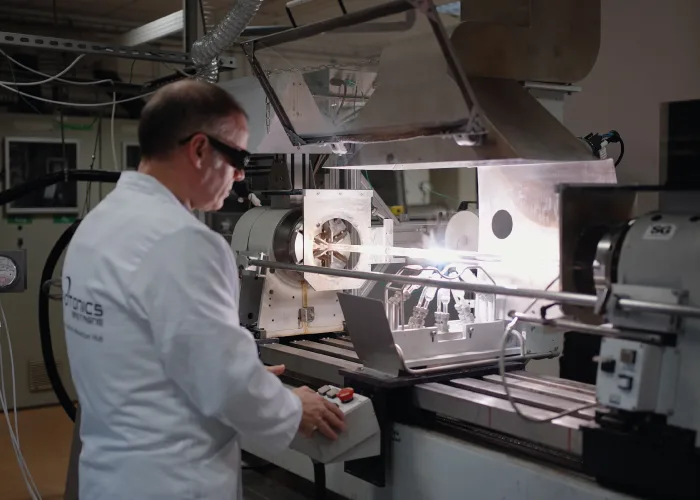
The microstructured (hollow) form within the fibre is produced using the stack & draw method, which involves taking several glass rods and tubes (capillaries) and stacking them in a tubular sleeve that holds them all together. The quality of this millimetre-scale assembly determines the dimensional tolerances of the future microstructure. This assembly is stretched several times to bring the entire structure down to the micrometre scale, while controlling the air pressure in the holes to prevent the (hollow) structure from collapsing.
Active (erbium, ytterbium, bismuth…),
Polarisation maintaining,
Photonic crystal and multicore,
Boron stress rods.
Fibre Drawing
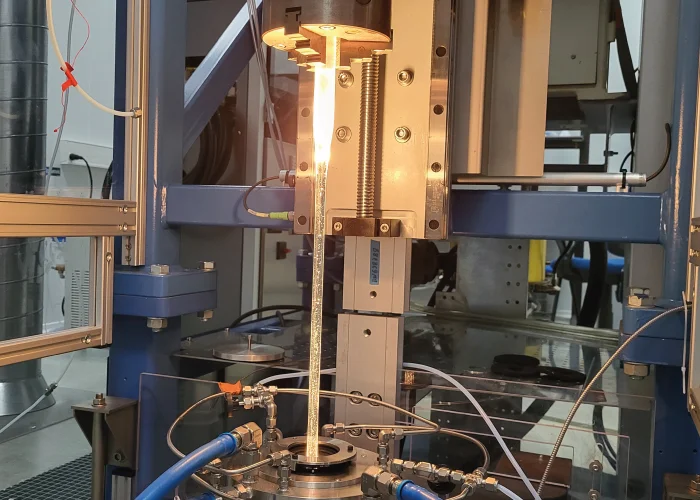
We draw our own preforms, manufactured in-house, but we can also, on request, draw from a preform supplied by our customer. We have the capacity to draw fibres up to one kilometre long, for a wide range of applications.
Capabilities: all type of silica glass preform,
Various coatings: polymer or metal with an optional carbon layer,
Taperised fibres.
Characterisation
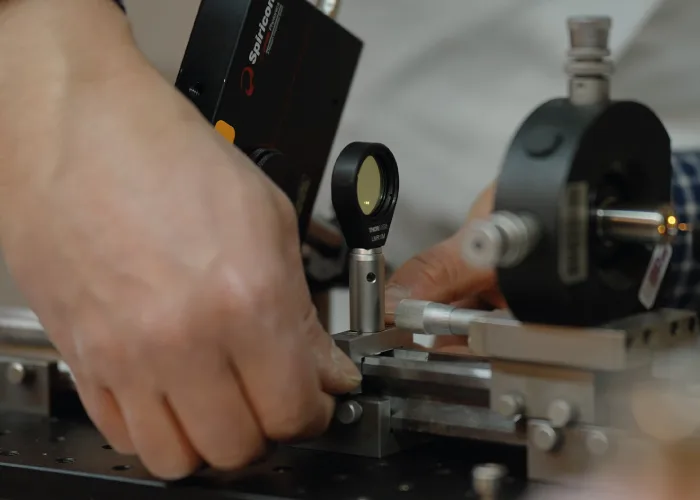
Our optical characterisation consists mainly of measuring the attenuation of the fibre over a range of wavelengths and for different bends applied to the fibre (winding diameter), as well as checking the spatial distribution of the exiting light. The level of birefringence is also quantified for polarisation-maintaining fibres. For active fibres, we measure other key parameters such as small-signal absorption using the cut-fibre method or pumping efficiency after integration on a laser characterisation bench.
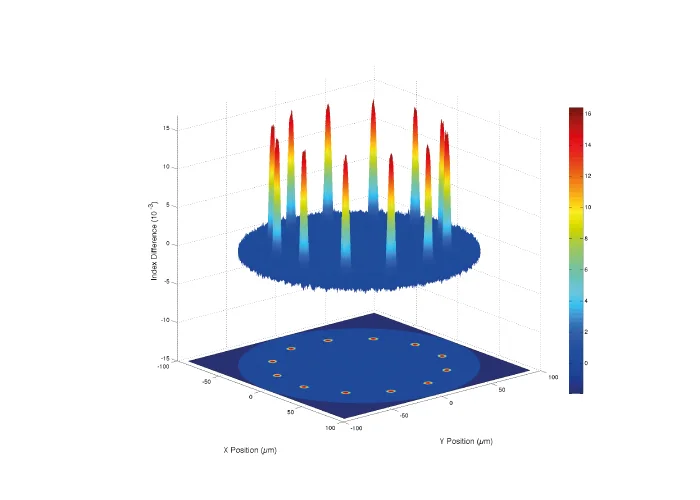
Refractive index profile on preforms and fibres,
SEM geometry,
EDS chemical composition,
Optical attenuation and reflectivity,
MFD, M², dispersion,
PER, birefringence,
Laser expertise.
Components
To support projects ranging from simple laboratory experiments to the development of an industrial product, we can carry out functionalisation operations on our fibres or on our customers’:
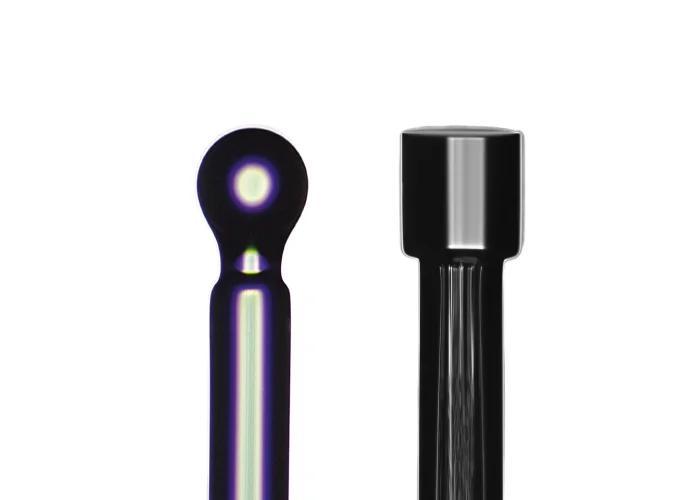
Careful cleavage of the fibre ends or addition of an end-cap or ball-lens,
Taperisation at the end or in the middle of the fibre (taper-type component),
Soldering to other fibres with optimised optical coupling (MFA-type component, combiner).
This brings us into the vast field of components, which may also require us to look at the heat dissipation or the mechanical protection of the manufactured component.