
27/03/2025 – The biophotonics team at Photonics Bretagne has just taken another step towards improving the One-Pix kit, a hyperspectral imaging solution developed by Photonics Open Projects. The project was initiated by Stéphane Perrin, head of biophotonics at Photonics Bretagne, who entrusted its implementation to Lisa Uguen (a student at ENSSAT doing a work-study placement at Photonics Bretagne). Working with the rest of the biophotonics team, she was able to integrate a novel profilometry function into the One-Pix. Presented at the Journées Imagerie Optique Non Conventionnelle (JIONC) by Stéphane Perrin, this work opens up new prospects for the scientific and industrial community using single-pixel hyperspectral microscopy.
A key advance: profilometry with the One-Pix
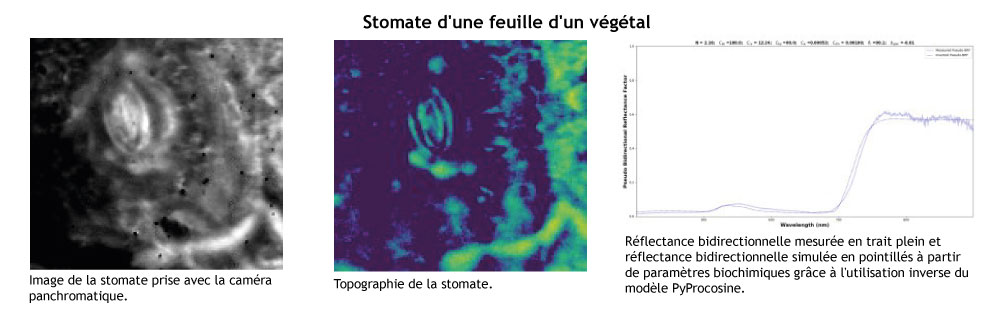
Until now, the One-Pix has been able to obtain two pieces of spatial information and one piece of spectral information (x, y, λ). Thanks to Lisa Uguen’s recent work, it is now possible to extract depth information as well, making it possible to obtain three spatial pieces of information and one spectral piece (x, y, z, λ). This advance is based on a reconstruction method based on the projection of fringes and analysis of their phase distortion. Lisa Uguen initially developed this approach for microscopy, enabling the characterisation of surfaces on a microscopic scale. Subsequently, the Photonics Open Projects team adapted its reconstruction code to extend it to macroscopy applications, making the technology accessible to a wider range of uses.
This new profilometry capability has been integrated into the One-Pix open-source repository, marking a significant step forward for the ONE-PIX community. With this update, One-Pix becomes an even more powerful tool: it can capture not only the three spatial dimensions of a scene, but also its spectral dimension. All that remains is to integrate the temporal dimension for video imaging, which would represent a step towards complete digitisation of reality.
An accessible and scalable imaging tool
The One-Pix kit stands out for its accessibility and flexibility, particularly for research teams and academics. By combining hyperspectral and single-pixel imaging, it offers an affordable solution for a variety of applications:
- Precision agriculture
- Optical sorting and surface characterisation
- Materials analysis
- Pharmacology and medical diagnostics
- Geology and mining
- Guided surgery
The addition of profilometry to the One-Pix makes it even more attractive for new applications, particularly in texture and relief analysis.
Recognition at the Non-Conventional Optical Imaging Conference
At the 20th Journées Imagerie Optique Non Conventionnelle at the Institut de Physique du Globe de Paris, Stéphane Perrin presented these advances as part of his work on ‘Single-pixel hyperspectral microscopy’.
The event, which has been bringing together researchers, engineers and industrialists for two decades, highlighted the growing importance of unconventional imaging and its many applications. Non-conventional imaging provides access to physical quantities invisible to the naked eye, such as optical index, chemical composition or polarisation properties. It is based on innovative techniques such as polarimetry, interferometry, ptychography and even single-pixel imaging, requiring extensive interaction between optical design, signal processing and the development of new sensors.
Thanks to the contribution of Lisa Uguen and the biophotonics team at Photonics Bretagne, the One-Pix continues to evolve, strengthening its role in research and industry. This breakthrough is a perfect illustration of the importance of open innovation and knowledge sharing in the development of tomorrow’s photonics technologies.