
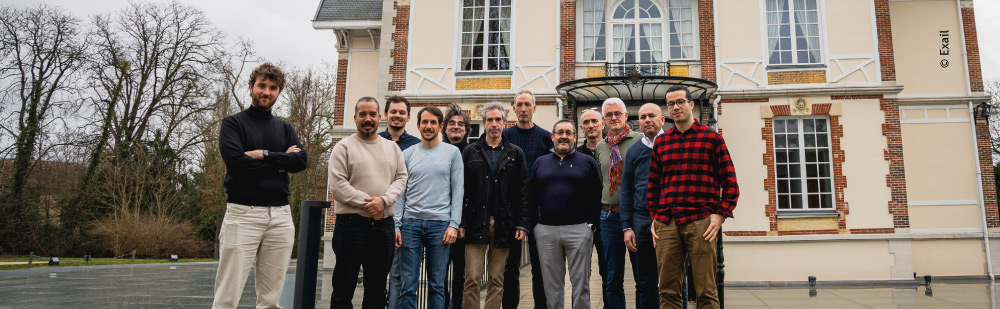
19/01/2026 – On Thursday 15 January 2026, the closing meeting of the 3F2E project – French Industry Chain of Fibre for Extreme Environments was held at the château Saint-Léger (iXcampus Saint-Germain-en-Laye), marking the culmination of four years of collaborative work in service of a technology that is strategic for French industrial sovereignty.
Carried out over the period 2022–2025, the 3F2E project is funded by the Nuclear Recovery Plan funding scheme and supported by Bpifrance, with an overall budget of €1.8m over 4 years. Its ambition: to develop specialty optical fibres with metallic and/or carbon claddings, capable of operating standalone or integrated into sensors, in extreme nuclear environments, subject to strong temperature and irradiation constraints.
A complementary consortium for a 100% Made in France industry chain
The 3F2E programme brings together a consortium of five partners with complementary expertise: Exail (project leader), Photonics Bretagne, SEDI-ATI, TechnicAtome and EDF, with the support of the industry chain’s GDO (optical fibre industry association).
The objective is clear: to build an integrated, 100% Made in France industry chain, capable of breaking free from foreign suppliers and guaranteeing national sovereignty over a technology critical to the nuclear sector and harsh environments.
The key role of Photonics Bretagne in the development of cladded fibres
Within the framework of the project, Photonics Bretagne intervened as a technological platform, in close co-development with Exail, with the main objective of designing optical fibres with metallic and carbon claddings.
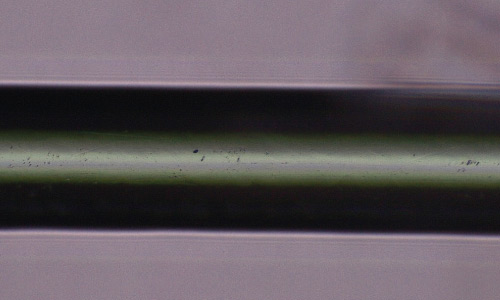
The 3F2E project required substantial technological development in order to achieve both the specifications of the requirements and a maturity equivalent to the world state of the art. One of the major technological lock points lay in controlling the microstructure of the deposited metal, in particular aluminium. This microstructure in fact plays a primary role in the optical and mechanical properties of the fibres, to the point that certain microstructures render the fibre unusable.
The success of the Photonics Bretagne teams was to define and master optimal fibring conditions, in order to obtain a smooth single-crystal microstructure, with the best properties, and over lengths of several kilometres of fibre. The stability and robustness of the developed process now allow the needs of the project’s industrial partners, EDF and TechnicAtome, to be fully met.
Industrial maturity achieved and a complete commercial range
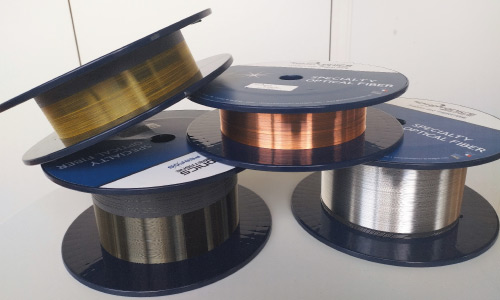
The success of the project rests both on the development of four totally distinct manufacturing processes for cladded specialty fibres – aluminium, copper, carbon and polyimide – and on reaching a high level of industrial maturity. These advances have enabled the commercialisation of a complete range of aluminium-clad optical fibres, including:
- different types of waveguides: single-mode, step-index multimode and graded-index multimode,
- several cladding diameters: 125 µm, 240 µm and 440 µm.
In total, around ten commercial references are already qualified and available for sale, via our partner Exail (E-shop).
Furthermore, in order to address the most demanding markets in terms of high temperatures and nuclear environments, the entire fibre range is offered:
- either with a germanium-doped core,
- or with a pure silica core optimised for radiation resistance.
Towards fully operational sensors
The 3F2E project also enabled SEDI-ATI by Fiber Optics Group to make key technological advances on the assembly and connectorisation of specialty cladded optical fibres, steps that are essential to their integration into operational sensors for nuclear and harsh environments.
EDF, end user of the technologies developed
From a user’s point of view, EDF and TechnicAtome were able to test the fibres under real conditions, as highlighted by EDF:
“EDF has used distributed optical fibre measurement for monitoring its installations for many years. However, current optical fibres are not suited to the extreme conditions encountered in certain environments (radioactivity, temperature…). The fibres developed within the framework of the 3F2E project perfectly meet this need and make it possible to consider extending the use of this type of measurement in nuclear power plants. Furthermore, these fibres have also demonstrated the possibility of measuring air temperature, with no sensitivity to thermal radiation.”
Outlook beyond the 3F2E project
Beyond the commercial outlook, the exceptional know-how acquired by Photonics Bretagne within the framework of the 3F2E project now offers new development possibilities, in particular by combining it with another of its areas of excellence: the manufacture of hollow-core optical fibres. Future innovations that are already the subject of the HOPEX project, illustrating the continuity of the efforts undertaken to push the limits of photonic technologies in extreme environments.